












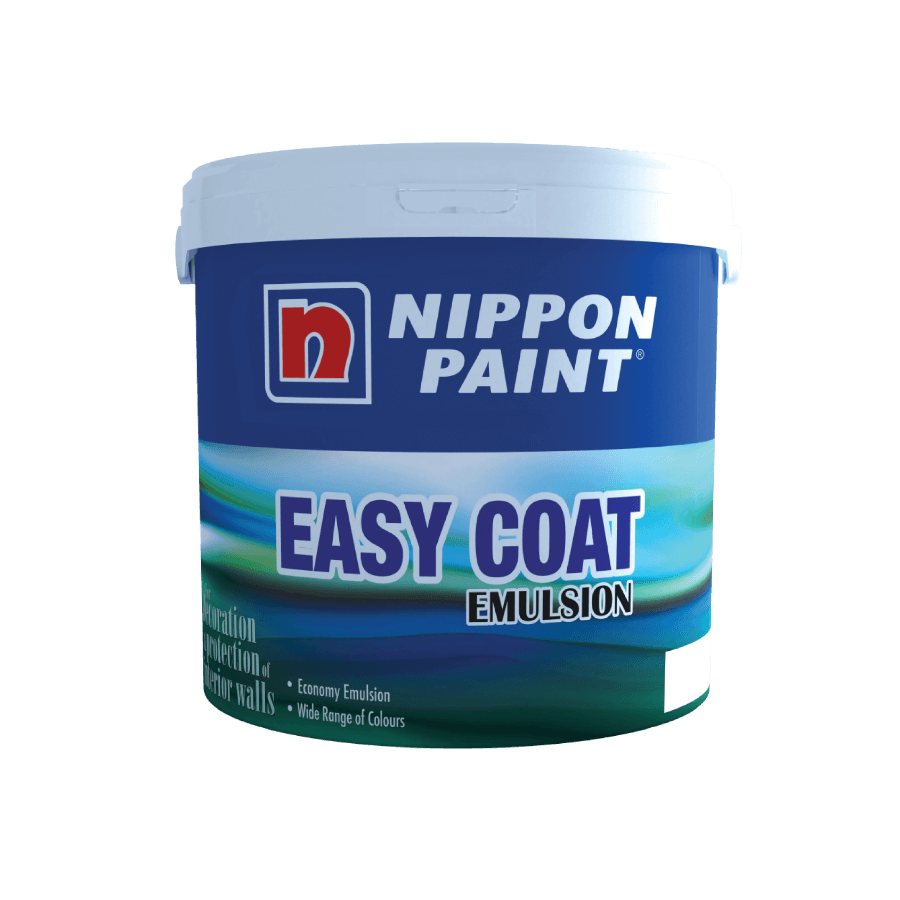
Nippon Easy Coat Emulsion for Islamabad and Rawalpindi interiors
A practical interior paint job needs a finish that suits the room and the project budget. Nippon Easy Coat Emulsion is Nippon Paint Pakistan's economy interior emulsion, designed for decoration and protection of interior walls, ceilings, plaster, brickwork and suitable wall boards. The manufacturer highlights its brushing and levelling properties, a wide range of colours and a flat-matt appearance.
For homeowners, painters and contractors in Islamabad and Rawalpindi, Easy Coat is worth considering when the brief is a straightforward, economical interior finish. The result still depends on sound plaster, the right sealer and putty system, correct dilution and enough drying time between coats.
What is Nippon Easy Coat Emulsion?
Nippon's technical data sheet (TDS), revised October 2025, identifies Easy Coat as an interior emulsion with a poly vinyl acrylic binder and clean water as its thinner. Nippon describes it as an economy product with good brushing and levelling properties and a choice of cool and vibrant colours.
The TDS also states that the product does not contain added lead, mercury, chromium or cadmium compounds. This is a specific formulation statement—not a reason to ignore normal painting precautions. Keep the product away from children and food, ventilate the room, and use suitable eye and respiratory protection during painting and sanding.
Where can you use Nippon Easy Coat?
Nippon recommends Easy Coat for decoration and protection of interior:
- Plastered walls and ceilings
- Brickwork and other suitable masonry
- Suitable wall boards and interior board surfaces
Its flat-matt finish suits rooms where a low-sheen appearance is preferred. The manufacturer also highlights its economical positioning and brushing and levelling characteristics.
Easy Coat is an interior emulsion, not an exterior weather coating or a waterproofing membrane. Do not use it to solve roof leakage, rising damp, plumbing seepage, active efflorescence or persistent condensation. Repair the moisture source and prepare the substrate before painting. For surfaces exposed to rain, standing water or frequent direct splashes, select a coating system specifically designed for that exposure.
See the Nippon Easy Coat product page at Al-Waqas Paint for the catalogue listing and current availability.
Nippon Easy Coat coverage, coats and drying time
The Nippon Paint Pakistan TDS revised October 2025 gives the following figures:
| Technical detail | Manufacturer guidance | | --- | --- | | Product type | Economy interior emulsion | | Binder | Poly vinyl acrylic | | Finish | Flat matt | | Theoretical coverage | 11–13 m² per litre per coat | | Recommended finish coats | 3–4 coats | | Touch dry | 15 minutes, depending on temperature and humidity | | Hard dry | 45–60 minutes | | Recoat interval | 2–3 hours | | Standard pack sizes listed | 3.64 L and 14.56 L |
Coverage is theoretical and per coat. Nippon notes that actual coverage varies with substrate conditions. Porous plaster, rough brickwork, repaired areas, colour changes, film thickness, application technique and wastage can all change the quantity required. Measure the paintable area and treat the TDS figure as an estimating guide, not a guaranteed site yield. Pack sizes may also change with availability.
Touch-dry does not mean ready for the next coat. Respect the stated 2–3 hour recoat interval and allow longer when the room is cool, humid or poorly ventilated. Temperature and humidity affect drying.
How to dilute and apply Easy Coat
The TDS gives tool-specific thinning by volume:
| Application tool | TDS dilution | | --- | --- | | Brush | 50–70% clean water | | Roller | 20–30% clean water | | Conventional air spray | 30–40% clean water |
Use clean water and follow the current product label. Do not assume that one tool's dilution rate applies to another. Excessive thinning can reduce film build and affect the finish.
A practical application sequence is:
- Confirm that the wall is sound, dry and properly sealed.
- Stir the paint thoroughly before application.
- Dilute only within the TDS range for the selected tool.
- Apply even coats without leaving heavy build-up, runs or missed patches.
- Allow the stated 2–3 hour recoat interval, extending it if site conditions slow drying.
- Clean brushes, rollers and other equipment with water immediately after use.
For a large job, test a small area first. It helps check the colour, appearance and actual consumption on the prepared surface.
Surface preparation: the most important step
Nippon's TDS gives separate preparation guidance for bare masonry, sound previously painted surfaces and badly defective walls. Do not apply finish paint over loose chalk, dust, grease, damp plaster or an unstable old coating.
New or bare plaster and masonry
- Allow plaster, brickwork and repairs to dry thoroughly. The surface must be free from dust, dirt and grease.
- If fungus is present, the TDS instructs treatment with a bleach solution. Follow the cleaner's label, wear gloves and eye protection, ventilate the area and never mix bleach with acids, ammonia or other cleaners. Let the wall dry completely after treatment.
- Apply one coat of Nippon Vinilex 5100 Wall Sealer or Nippon Vinilex 5200 Wall Sealer and allow it to dry thoroughly.
- Where levelling is required, apply Nippon ACS Putty or Nippon A-100 Wall Putty. The recommended masonry system lists 2–3 putty coats.
- Once the putty is dry, sand the surface smooth and remove all dust before applying Easy Coat.
Nippon's TDS says the recommended painting specification requires wall moisture to be below 16% when measured with a Protimeter and wall alkalinity to be below pH 9. If either reading is outside that limit, do not cover the wall. Allow it to dry further and investigate the cause of excess moisture or alkalinity.
Previously painted walls
For a sound old coating, remove unstable paint film and loose chalk by rubbing down with suitable abrasive paper or a wire brush. Dust off thoroughly, then prime with Nippon Vinilex 5100 or Vinilex 5200 Wall Sealer. Fill defects with ACS Putty or A-100 Putty where necessary, allow the filler to dry, sand and remove the dust.
For large cracks and holes, the TDS specifies repair with a sand-and-cement mixture and thorough drying before priming and filling. Do not simply bridge moving cracks or paint over water-damaged plaster; correct the underlying defect first.
Recommended masonry coating system
Nippon's TDS lists this sequence for masonry:
| Stage | Product | TDS coat guidance | | --- | --- | --- | | Sealer | Nippon Vinilex 5100 or Vinilex 5200 Wall Sealer | 1 coat | | Putty | Nippon ACS Putty or A-100 Wall Putty | 2–3 coats | | Finish | Nippon Easy Coat Emulsion | 3–4 coats |
Choose the sealer and putty to suit the actual wall condition, and allow each layer to dry as instructed. You can also review the Vinilex 5100 Wall Sealer, Vinilex 5200 Wall Sealer, ACS Putty and A-100 Wall Putty catalogue pages.
Moisture, weather and safety cautions
- Keep it for interior use: the manufacturer classifies Easy Coat as an interior emulsion. Do not use it as an exterior weatherproof coating.
- Do not paint damp walls: moisture must be below the TDS limit, and wall alkalinity must be below pH 9. Fix leaks and seepage before decorating.
- Allow for humid conditions: high humidity and lower temperatures can extend drying and recoat times. Keep the room ventilated and do not rush the next coat.
- Use normal protective equipment: Nippon advises good ventilation, avoiding inhalation of vapour and sanding dust, avoiding eye and skin contact, and wearing eye protection, protective clothing and a mask while applying the paint.
- Store and dispose of it carefully: keep the container upright in a cool, dry place, away from children, food and drink. Do not swallow the paint or discharge leftover paint and washings into drains or the environment. Follow the product label and local disposal requirements.
Is Nippon Easy Coat the right choice for your project?
Nippon Easy Coat is a sensible option to discuss when you need an economical flat-matt finish for ordinary interior walls and ceilings and the surface can be prepared properly. Its TDS-backed coverage and tool-specific dilution help painters plan the work, but actual consumption depends on the wall and application conditions.
If the room needs a specifically washable, stain-resistant or moisture-management coating, do not assume those properties from the word “emulsion” or from the economy positioning. Compare the relevant manufacturer's product data and choose a finish designed for the room's demands.
Get Nippon Easy Coat in Islamabad and Rawalpindi
Al-Waqas Paint & Hardware can help you check the available pack sizes, colour options and the right preparation system for your walls. When asking for an estimate, share the approximate wall area, whether the plaster is new or previously painted, and a photo of the surface condition.
Search keywords
Nippon Easy Coat price in Pakistan, Nippon Easy Coat Islamabad, Nippon Easy Coat Rawalpindi, Nippon Easy Coat Emulsion coverage, economy interior emulsion Pakistan, flat matt wall paint Islamabad, budget interior paint Rawalpindi, Nippon interior wall paint, Nippon Easy Coat drying time, paint for plastered walls and ceilings, interior emulsion dilution, Nippon Vinilex 5100 Wall Sealer, Al-Waqas Paint & Hardware.